

Dentaccès
Find resources and solutions that may be available to you

Programs to support your oral health
In collaboration with its Foundation, the Ordre des dentistes du Québec invites you to discover, all in one place, government programs and resources that help improve access to dental care. Check out the summary tables to more easily see the options available to you.
Adult Cancer: Oral Radiotherapy Program
For whom?
People with cancer treated with radiotherapy in the head and neck region.
What is covered?
Before radiotherapy:
– Exams and X-rays
– Mouth guards (fluoride trays)
– Radiation lead shields
– Tooth extractions
– Dental cleanings (scaling)
– Fillings/restorations
After radiotherapy:
– Exam on the last day of radiotherapy and one month afterwards
– Restorations (fillings) up to 12 months post-radiotherapy
– Acrylic or metal-acrylic prostheses (dentures or partials) up to 12 months post-radiotherapy
How to access?
Through the oncology department of your hospital,
Find out more……
Please refer to the oncology department at your hospital.
Childhood Cancer: Pediatric Oncology Dental Care Program
For whom?
Individuals diagnosed with cancer before the age of 18.
What is covered?
Peri-oncological period (during treatment of the problem):
– Exams and X-rays
– Fluoride trays
– Radiation shields (to direct X-rays)
– Extractions (tooth removal)
– Scaling (cleaning) & fluoride treatments
– Restorations (fillings)
– Space maintainers
– Removal of orthodontic appliances (braces)
Monitoring period (after the problem has been addressed):
– Exams and X-rays
After treatment (during follow-up of sequelae):
– Orthodontics (braces)
– Periodontics (gum treatment)
– Implantology
– Endodontics (root canal treatments)
– Prosthodontics (crowns, bridges)
How to access
Through its oncology department
Lear more…
Social Assistance Program
Since 2024–2025, people receiving social assistance benefits can also register for the Canadian Dental Care Plan (CDCP). Their claim booklet gives them access to certain free services, while the CDCP provides coverage during the waiting period and covers treatments not payable by the RAMQ, such as root canal treatments. It is therefore advisable to register for the CDCP, even if you are already covered through RAMQ. People concerned must make an appointment with a dentist who participates in both programs.
For whom?
Recipients of the social assistance program (with a valid claim booklet) and their dependents.

What is covered?
Covered for less than 12 consecutive months
Dental emergencies: infection, abscess, hemorrhage, trauma, bone fracture, reimplantation of exfoliated teeth (knocked out), repair of soft tissue tears (e.g., cheek, tongue, lip).
To ensure that the treatment will be covered, describe the situation as precisely as possible when making the appointment. If you are registered with the CDCP, this plan may cover treatments during this period.
Covered for more than 12 months, but less than 24 months
– Dental emergencies
– Preventive care: annual exam, X-rays, scaling (age 16 and over)
– Curative care: silver amalgam fillings for premolars and molars, white composite fillings for esthetic cavities, certain endodontic treatments, prefabricated crown
Covered for more than 24 months
– Dental emergencies
– Preventive care
– Curative care
– Prosthetic services, with prior written authorization from your Local Employment Centre (CLE):
• Fabrication of new complete and/or partial acrylic dentures every 8 years
• Relining of a denture every 5 years and at least 3 months after it is obtained
• Replacement of lost or broken dentures – covered at 50%
• Replacement of dentures following oral surgery
• Addition of a structure (tooth) to a partial denture
Dependent children
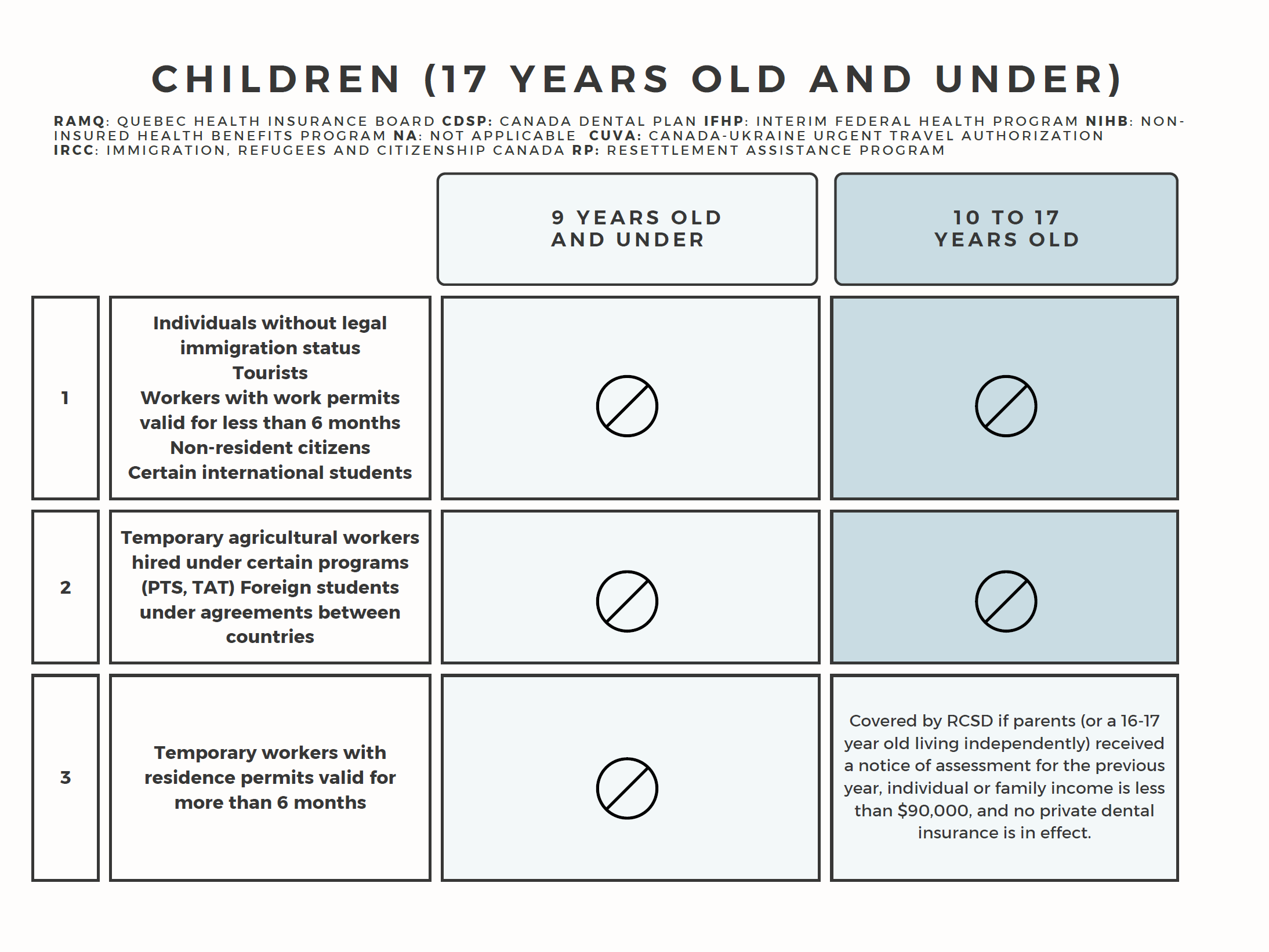
– Under 10 years old: covered by RAMQ (see RAMQ program for children 0–9 years old) and under 18 years old
– Covered for more than 12 months:
• Fluoride application for ages 12–15
• Cleaning starting at age 12
• Scaling starting at age 16
• Root canal treatment and apexification on an adult tooth before age 13
How to access?
– Call your dentist to ask if they participate in the RAMQ program
– Bring your claim booklet to the appointment
– Bring your RAMQ card to the appointment
– Bring your CDCP card if you are registered
Learn more…
Cleft Lip and Palate and Craniofacial Anomalies Program
For whom?
People with a cleft lip or palate or with certain craniofacial anomalies (e.g.: syndromic and non-syndromic craniosynostoses, distraction osteogenesis).
What is covered?
– Hygiene (cleanings) and preventive care (e.g., fluoride)
– Orthodontics (braces)
– Surgery
How to access?
Through the pediatric dentistry service in a hospital setting.
Learn more…
Please refer to your hospital pediatric dentistry service.
Maxillofacial Prostheses Program
For whom?
Adults covered by RAMQ, who have had head and neck cancer with significant sequelae in the mouth, and referred by a dentist or physician related to oncology.
What is covered?
– Consultation, exam
– Implantology
– Prosthodontics (crowns and precision and semi-precision attachments; palatal obturator; implantology for fixed or removable prostheses, flap and maxillectomy protectors)
– Epithesis (silicone prostheses), craniofacial implantology; plastic surgery for small facial flaps
– Fillings
– Hygiene (cleanings) and preventive care (e.g., fluoride)
– Surgery
How to access?
Through your oncology service.
Learn more…
Please refer to your oncology service at your hospital.
Non-Insured Health Benefits (NIHB) Program for Indigenous and Inuit Communities
For whom?
Members of Indigenous and Inuit communities.
What is covered?
– Annual and emergency exams
• Hygiene (cleanings) and preventive care (e.g., fluoride)
• Local or general anesthesia and sedation
• X-rays
• Restorations (fillings)
• Endodontics (root canal treatments)
• Surgery
• Removable prostheses (dentures and partials)
• Fixed prostheses (crowns and bridges)
• Orthodontics (severe cases only)
How to access?
Through dental clinics in the communities or through dentists who are NIHB providers.
Learn more…
Visit the Government of Canada website.
For dentists:
Interim Federal Health Program (IFHP)
For whom?
Resettled refugees, protected persons in Canada, asylum seekers, victims of human trafficking, and detainees who do not have provincial, territorial, or private health insurance. The duration of coverage under IFHP varies by group.
What is covered?
– Emergency exam and X-rays
– Restorations: cavities, trauma, pain treatment, restorations
– Prosthodontic services: complete and partial dentures, repairs, relining
– Surgical services: simple and complex extractions and, for specialists only, various complementary and supportive treatments
– Prosthodontic services: complete and partial dentures, relining and repairs
How to access?
– First check if your dentist is registered in the program
– Present your eligibility document (commonly called the brown card) to the dentist before requesting care
Learn more…
Visit the Government of Canada website
For dentists:
– Register as a health service provider.
– For dental treatments exceeding $2,000 per year, the dentist will need prior authorization. To do so, simply send a request for pre-authorization by email to [email protected]; the pre-authorization request must include the list of treatment codes (ACDQ codes) as well as the associated X-rays.
– For more details on coverage and eligible persons.
Quebec Oral Health and Daily Oral Hygiene Program in Long-Term Care Centers (PQSBHB in CHSLD)
For whom?
All people living in:
– Public CHSLDs
– Contracted private facilities
– Purchased places in non-contracted private facilities
– Seniors’ homes
– Alternative homes
What is covered?
Free:
– Oral health assessment upon admission by the nurse
– Daily oral hygiene care provided by the orderly (materials included)
Preventive care by the dental hygienist. These vary according to the person’s needs and include: marking the name on dentures, professional denture cleaning, scaling of natural teeth, application of fluoride varnish, and application of silver diamine fluoride.
Curative and prosthetic care by the dentist and denturist:
Annual free coverage of $1,000 per resident.
The care includes :
– Exams
– Fillings
– Tooth extractions
– Root canal treatment, according to the dentist’s clinical judgment
– Repair and fabrication of dentures
Any costs exceeding $1,000 are the responsibility of the resident, based on their ability to pay and according to the rules related to special needs determined by the Government of Quebec ((Goods and services not covered by the contribution of institutionalized adults, allowances for personal expenses, and rules related to the special needs policy).
How to access?
This program is being implemented province-wide and has been offered in the above facilities since 2019.
Learn more…
General Anesthesia
Some people request to be put to sleep in the hospital to receive dental care. Several options are available.
– First, discuss with your dentist, as some dental clinics offer partial sedation (gas, intravenous products, or a pill to relax).
– General anesthesia (being completely asleep) is covered by RAMQ. However, dental care is not always covered. Coverage depends on your eligibility for other programs.
– Waiting lists can be long, and the service may be reserved for priority cases.
Mobile Dental Clinics (at home)
There are some mobile dental clinics that travel to homes. This is a service at your own expense. Check if a private clinic offers this service in your region.
Quebec School Dental Sealant Program (Elementary and High School)
For whom?
– Grade 2 elementary students attending a public school in Quebec
– Grade 2 high school students attending a public school in Quebec
Some exceptions apply:
– Not all schools currently offer this service. It depends on the resources available at the CISSS or CIUSSS in the region concerned.
What is covered?
First visit of the dental hygienist at the school to:
– Assess the needs of each student
– Send authorization forms to parents
Second visit of the dental hygienist at the school to provide services that have been accepted by the parents and the student. These services may include:
– Application of dental sealants on the 1st and 2nd permanent molars
– Application of silver diamine fluoride
How to access?
When a school offers the service, you will receive an information letter and authorization forms.
Learn more…
Visit the website of the Ministry of Health and Social Services.
RAMQ (Children 0–9 years old)
For whom?
– Children 9 years old and under with a valid health insurance card
– Refugees and asylum seekers 9 years old and under meeting certain conditions
What is covered?
– Dental emergencies
– Annual exam, X-rays, silver amalgam fillings for premolars and molars, white composite fillings for esthetic cavity repairs, extraction of teeth and roots, certain endodontic treatments (root canals), prefabricated crown
– Not covered: cleaning, scaling, fluoride application, sealants, orthodontics
How to access?
Consult your dentist.
Learn more…
Private Dental Insurance
Some people have private dental insurance. If this is your case, check the extent of your dental care coverage with your insurer.
Surgical Dental Care Covered for All in Hospitals
For whom?
Patients with a Quebec health insurance card who need oral surgery.
For what?
– Exams, local or general anesthesia, intravenous sedation, and X-rays related to surgery
– Removal of a cyst or tumor
– Drainage of an abscess
– Reduction of a fracture
– Repair of a soft tissue tear (e.g., cheek, tongue, palate)
– Treatment of bone tissue inflammation
– Treatment of the temporomandibular joint, which connects the lower jaw to the skull
– Treatment of salivary glands
– Bone grafts
– Biopsies
– Muscle injections for myofascial pain
Some exceptions apply:
– You must pay for tooth and root extractions, except for children under 10 years old and recipients of last-resort financial assistance.
– Dental implants are not covered, except for people covered by the maxillofacial prosthesis program following cancer.
How to access?
– In a hospital with an oral and maxillofacial surgery department
– By referral from your family doctor, dentist, or oral and maxillofacial surgeon
Learn more…
Canadian Dental Care Plan (CDCP)
The Canadian Dental Care Plan (CDCP) was established by the federal government to make dental care more affordable for Canadians.
For whom?
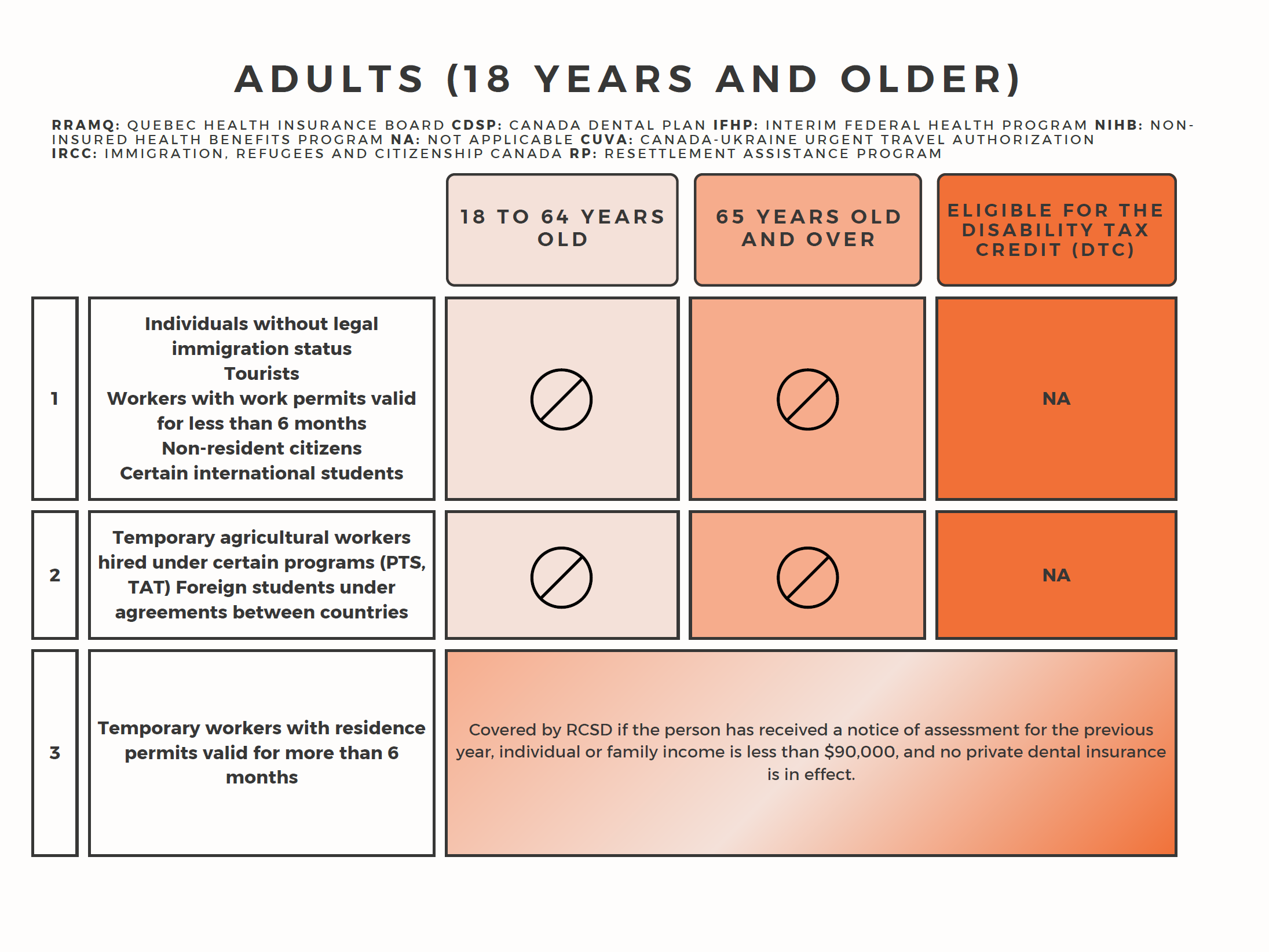
The CDCP is for Canadian residents who do not have access to private dental insurance and whose adjusted family net income is less than $90,000 per year.
How to access?
– Check your eligibility (age, income, no private dental insurance, federal Notice of Assessment)
– Submit an application:
• Online via the « My Service Canada Account (MSCA)” portal »
• By phone at 1-833-537-4342
-Once you have submitted an application and are eligible for the CDCP, you will receive a letter from the Government of Canada with your CDCP member ID number, the effective date of your coverage, and the co-payment level. You can use your letter to book your first appointment with a participating provider (starting from the effective date of your coverage).
– CDCP members must renew their application to the CDCP each year to avoid an interruption of coverage.
Learn more…
For more information on covered services, visit the Government of Canada website.

Check your eligibility for the Canadian Dental Care Plan (CDCP)
In addition to the programs mentioned above, you may be eligible for the Canadian Dental Care Plan (CDCP). To find out, check your eligibility on the Government of Canada website.

In addition to the programs mentioned above, you may be eligible for the Canadian Dental Care Plan (CDCP). To find out, check your eligibility on the Government of Canada website.
There are places that offer dental care at reduced cost or for people in need. Please note that the availability of these services is limited. Many of these dental projects are non-profit organizations, volunteer projects, or other organizations with limited resources.
Montreal Island
La clinique dentaire Jim Lund (Personne itinérante ou sans-abri)
Cégep John Abbott (Sainte-Anne-de-Bellevue)
Cégep de Maisonneuve (Montréal)
Clinique dentaire de l’Université de Montréal
Lanaudière
Projet Bouche B à la Clinique dentaire de l’École L’Argile et du CISSS Lanaudière à Joliette